

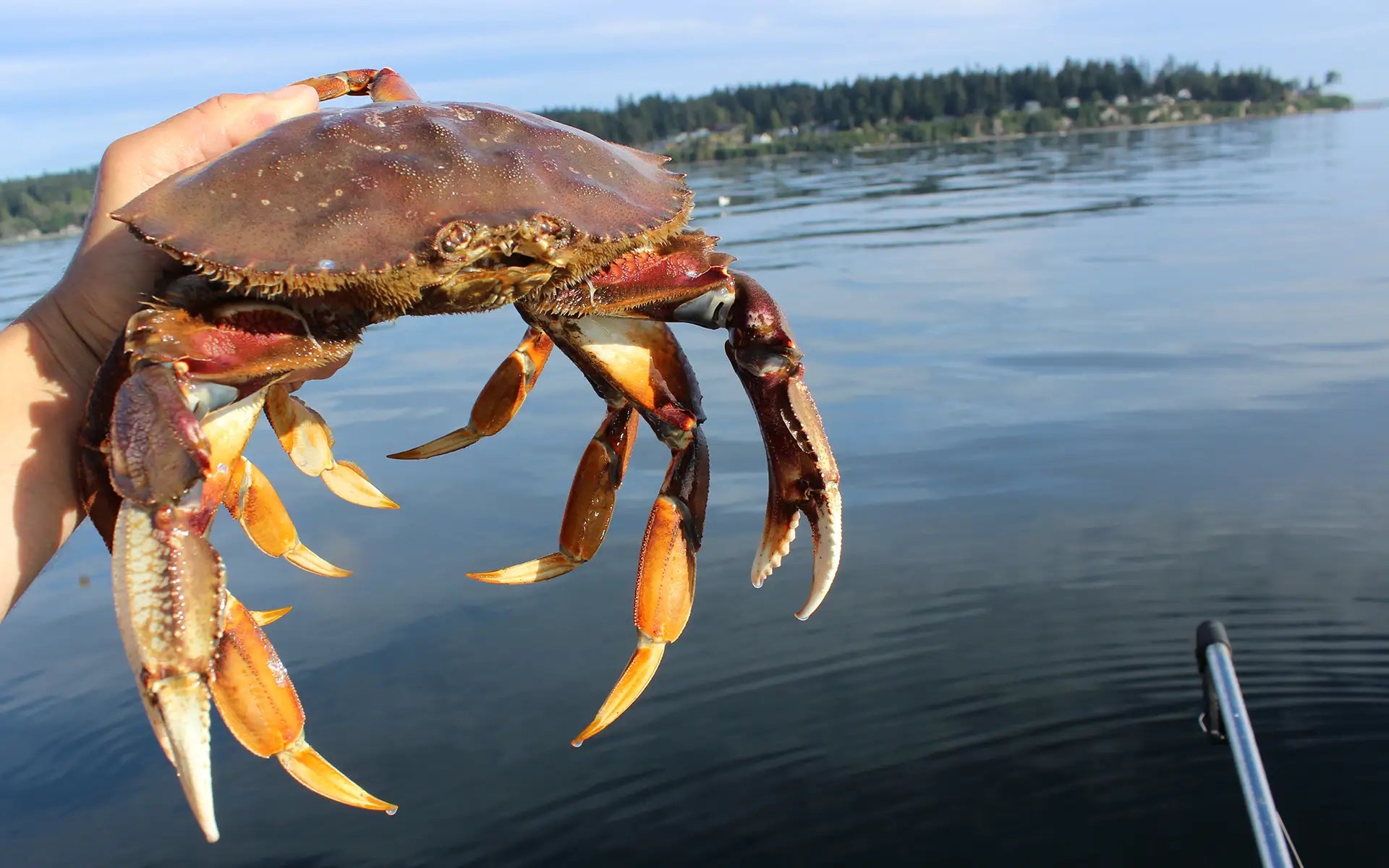
Excitement builds every year just before the announcement of the Puget Sound crab seasons. There’s nothing better than pulling up a crab pot to find it full of Dungeness crab, and the amazing meal that will soon follow. Every year there are more than 1.5 million pounds of Dungeness Crab pulled out of Puget Sound by recreational harvesters, using pots, rings and snares, making it one of the regions most popular fisheries. Get in on one of the Pacific Northwest’s most important traditions, whether you’re dropping pots in Everett, soaking a crab ring off the pier in Tacoma, or casting a crab snare off the shore in West Seattle.
Seattle Fishing Co. Crabbing Gear Page

Dungeness Crab are one of the Puget Sound's greatest prizes, so tasty and fun to catch!
Puget Sound’s Dungeness & Red Rock Crab
Most Puget Sound crabbers focus their attention Dungeness Crab. They are large, delicious and known for their sweet and tender meat. They are the true Pacific Northwest catch and the reason most people buy a crab pot in the first place. Red Rock Crab are their smaller cousin, still tasty, and often caught at the same time as Dungeness Crab. They have their own limits, so you can add any legal Red Rock Crab to your Dungeness limit, should you be so lucky to catch both.
Dungeness Crab Limits
In Puget Sound, only male Dungeness Crab can be retained. They must be over 6.25” and in hardshell condition. You’ll need a proper crab measuring gauge and make sure they are over the size restriction between the shell points, rather than simply side to side. Accidentally keeping undersized crab can be a problem should you get checked by a game warden.
Red Rock Crab Limits
Red Rock Crab need to be at least 5” across, also in hardshell condition. Either male of females can be kept.
Softshell crab, those that have recently molted and haven't hardened their new shell yet, must always be released. This isn't just a technicality; softshell crab have less meat and a much lower survival rate if kept and handled roughly, so protecting them helps the population rebound.
Seattle Fishing Co. Crabbing Gear Page

Measuring Dungeness Crab behind inside the outer points of the shell.
How to Identify Male vs. Female Crab
Flip the crab over and look at the abdominal flap (apron) on the underside. Males have a narrow, triangular apron, while females have a broader, rounded, dome-shaped apron used for carrying eggs. Male Dungeness crab are legal to keep in Washington waters; females must be released. Always check current WDFW size and sex regulations before harvesting, as rules vary by marine area.

Dungeness Crab - Female (left) and Male (right)
Crabbing Licenses and Reporting
Crabbing in Puget Sound comes with more paperwork than most freshwater fishing, and for good reason: the data collected directly shapes future seasons. Anyone16 or older needs a valid recreational fishing combination license or a Shellfish/Seaweed license, and every crabber, regardless of age must also carry a Puget Sound Crab Endorsement along with a paper or electronic Catch Record Card.
Crabbers are required to record their Dungeness harvest on their digital cards immediately after deciding to keep them. There are separate digital crab cards issued for the summer and winter seasons, but reporting on the new WDFW app makes life easy. Even if you don’t retain a single crab, you must have the endorsement before heading out to go crabbing.
Seattle Fishing Co. Crabbing Gear Page
Puget Sound Crabbing Seasons
Puget Sound's crab seasons are set separately from the Washington Coast, where crabbing runs year-round in places like Grays Harbor, Willapa Bay, and the lower Columbia River without a CRC requirement. Inside the Sound, seasons are announced each June for summer and September for winter, and dates vary by marine area rather than applying uniformly across the whole management zone, which stretches from Marine Areas 5 through 13, covering the Strait of Juan de Fuca, San Juan Islands, Puget Sound, and Hood Canal. Check out WDFW Seasons by Marine Area.
For the 2026 summer season, WDFW crustacean biologist Don Velasquez described conditions as broadly similar to 2025, with crabbing expected to be strong in northern areas such as Admiralty Inlet, Deception Pass, Port Susan, and the San Juan Islands. The northern-tier marine areas of Neah Bay, Sekiu and Pillar Point, East Juan de Fuca Strait, Deception Pass, Port Susan/Everett, and Admiralty Inlet opened July 2 through September 1, 2026.
Central Sound crabbers should take note of a meaningful change this year: because of increasing crabbing pressure combined with lower Dungeness abundance found in recent surveys, the waters around Seattle and Tacoma are now limited to two open days per week, rather than the more generous schedules of past seasons. Meanwhile, two areas remain closed entirely for conservation reasons: Marine Area 13 (South Puget Sound) and the portion of Marine Area 12 (Hood Canal) south of a line east of Ayock Point are closed until further notice to protect weak crab populations. Anyone planning a trip should check the current marine-area map before heading out, since these boundaries and open days can shift year to year based on the health of local stocks.
Winter season typically follows a similar area-by-area pattern, with many marine areas reopening around October 1 for seven-day-a-week crabbing through the end of December, though the same conservation closures in South Puget Sound and southern Hood Canal generally carry over.
Check out WDFW Crab Seasons and Areas

Dungeness Crab caught on a short soak with a cage full of salmon carcass for bait.
Crab Daily Limits for Puget Sound areas
Across the Puget Sound area, the daily limit is five Dungeness crab per person, males only, in hard-shell condition, a reduction from the historic 12-crab coastal limit reflecting the more pressured nature of inland waters. Red Rock crab limits run higher —six of each species per day, either sex, provided they meet the minimum size.

Captain Paul Kim is one of Puget Sound's popular charter operators and offers crabbing trips!
Best Places to Catch Crab in Puget Sound
Puget Sound offers some of the finest recreational crabbing on the West Coast, with Dungeness and red rock crab thriving in its cold, nutrient-rich waters. Whether you're dropping pots from a boat in deep channels or working rings off a pier, these prime locations across Washington's marine areas deliver consistent, rewarding catches.
Boat Locations
For boat crabbers, Marine Area 9 (Admiralty Inlet) around Port Townsend and Whidbey Island consistently produces strong Dungeness numbers, especially in the deeper channels near Fort Casey and Bush Point. Marine Area 10 (Seattle-Bremerton) offers convenient access from Elliott Bay and Blake Island, with productive drops along the eastern shore of Bainbridge Island and near Blakely Rocks. Hood Canal (Marine Area 12) is a longtime favorite, particularly around Dabob Bay and the Ayock Point area, where sandy-mud bottoms in 30-60 feet hold good populations. The trenches off Point No Point and Kingston in Marine Area 9/10 are reliable, particularly on an incoming tide when crab move shallower to feed. Always confirm current WDFW season dates and area closures before heading out, as Puget Sound crabbing is managed tightly by sub-area.
Pier and Shore Locations
Shore and pier crabbers do well at Redondo Pier and Des Moines Pier in South King County, both rigged with dedicated crab-cleaning stations. Edmonds Pier is another solid bet, with easy parking and consistent Dungeness and red rock crab in the adjacent shipping lane drop-off. In Hood Canal, the public dock at Salsbury Point County Park offers good shore access with minimal current. Point Defiance Park in Tacoma provides both pier and beach options with strong tidal flow. For a quieter spot, Cornet Bay near Deception Pass rewards patient shore crabbers working the eelgrass edges at low tide.
Seattle Fishing Co. Crabbing Gear Page

Edmonds Pier is one of the many good options for those crabbing without a boat in Puget Sound.
Puget Sound Crabbing Gear & Technique
Most Puget Sound crabbers use baited pots or rings, though the regulations allow more creative approaches too. Dip nets, hook-style devices, and even hand-catching while diving are all legal methods, so long as nothing pierces the shell, spear-style gear that penetrates a crab is not allowed. Check out WDFW Crab Gear Rules.
Timing matters as much as gear selection. Crab gear may only be worked during daylight hours: so setting or pulling traps from a vessel is restricted to one hour before official sunrise through one hour after official sunset, and all gear must come out of the water on days the area is closed. Placement matters too, pots can't be set in ferry lanes, shipping lanes, or near ferry terminals, and crabbers are asked to steer clear of marina entrances and boat launches so other users aren't blocked.
Bait choice is where a lot of local knowledge comes in. Fresh or frozen fish carcasses, chicken, and specialty crab bait all work, but oilier baits with strong scent trails tend to draw crab in faster across the Sound's often murky, current-driven water. Soak times of 30 to 45 minutes for rings and one to three hours for pots are typical in areas with good current flow, since crab need time to find and enter a pot. Overnight pot soaks can yield the best results, as long as you drop them on an open day and pull them before a closed day.
Some of our most popular gear choices from Seattle Fishing Co. Crabbing Gear Page
- Red & White Crab Floats
- Sinking Crab Line
- Crab Pot & Ring Harnesses
- Bait Cages
- Dungeness Crab Measuring Gauges
- Crabbing Gloves
Puget Sound Tides & Crabbing
Tides and currents play a major role in Puget Sound crabbing success, since Dungeness and red rock crab shift their feeding patterns with water movement. Crab tend to become more active and mobile during moderate tidal exchanges, moving into shallower water to feed as the incoming tide pushes bait and scent further inland. Slack tide, the brief window between tide changes, is often considered prime crabbing time because pots sit still on the bottom without dragging, allowing bait scent to disperse evenly and pots to soak effectively. Strong currents, especially during large tidal swings around new and full moons, can drag pots out of position, tangle lines, or make retrieval difficult and unsafe from a boat. Checking a tide chart alongside local current predictions is one of the simplest ways to improve catch rates.

Checking out a jumbo Dungeness Crab to make sure it's in hard-shell condition, if the shell is soft, send it back!
Handling Your Catch
Crabbers are required to keep the back shell attached to any crab in the field as it's unlawful to possess crab without the shell intact, which allows enforcement and other crabbers to verify size and sex at a glance. When releasing undersized crab, females, or softshell individuals, a gentle return to the water matters: crabbers fishing from a pier or high dock should lower released crab in a bucket rather than tossing them back from height, since impact injuries reduce survival even when the crab swims away.
Seattle Fishing Co. Crabbing Gear Page

Full limits of Dungeness Crab will offer a feast for the full family!
Plan your own Puget Sound Crabbing experience
Puget Sound's crab fisheries reward crabbers who pay attention to the details: knowing your marine area's open days, checking tides before you head out, and handling your catch with care. With over 1.5 million pounds harvested recreationally each year, this Pacific Northwest tradition depends on everyone following the rules that keep populations healthy for seasons to come. Whether you're working a boat pot in Admiralty Inlet or soaking a ring off Edmonds Pier, success comes down to preparation, patience, and respect for the resource. Grab your gauge, check the current regulations, and get ready for one of the region's most rewarding fisheries.


